Saturday, October 29, 2005

Weekend word I

Do you watch those home remodelling shows? You know the kind: they have thirty minutes to show you what must have taken weeks to do. The ones that try to show you how to do things cheaply make me laugh. When they suggest the cheapest, fastest, easiest way to make things look new, what do they recommend? Say it with me now: "Painting!" But I am here to tell you, if you want the job to look good from closer than nine yards away, painting is NOT cheap, fast, or easy. Today I primed the kitchen pantry. Tomorrow, I will put on the first finish coat. I'm exhausted. Here's what I don't like about painting.

  • All the time it takes to prepare to paint and clean up afterwards. What a production! If I want to make a table, let's say, I just go into my shop, make some measurements and start whacking boards. I don't have to sand and vacuum and wash with TSP and rinse the boards first--I just cut 'em. And then there is the cleaning. I never use oil-based paint and I still find cleanup to be tedious drudgery.
  • Then there is the drying time when everything that was in the cabinet or on the wall has to remain somewhere else while the paint is drying (all the while stinking up the house).
  • Drips. And I'm not talking about those people who drop by, observe the junk all over the dining room table, sniff the air, and ask, "Are you painting or something?" I mean the kind that ooze down the wall while you aren't looking or land on the grout of the tiled floor and then smear when you step on them. Arrrrgh!

Well, that's not what we are here to talk about, is it? It is time for an i-word. It is tempting to just use inchoate, but that appeared tangentially under the Weekend word C listing. No, you deserve a new word. Here's one that I use when teaching New Testament studies: INTERCALATION [in-ter-kuh-LAY-shun]. Basically that's a big word for a sandwich filling. It technically means anything that is inserted in between two others that are in a series. So in the Gospel of Mark, for example, the author tells the story of Jesus cursing the fig tree but he interrupts himself by inserting the story of Jesus clearing the temple. Then, as he tells it, the next day Jesus and the disciples pass the same way, and, whatta ya know, the fig tree is withered! That temple-clearing story, that's an intercalation. Look at Matthew's account--he tells it straight through, cursing and withering on the same day.
Well, I hope you enjoy this word because it's all you're getting tonight. I'm pooped, the heater is running, and I must take a shower. Hey, no more daylight savings time tomorrow--yahoo!

Friday, October 28, 2005

Pre-Halloween identification

Anthony Fetyplace
Well, I was going to wait until Halloween to reveal the identity of the "watzat" but due in part to certain whiners (you know who you are), I will just post it all now. What was variously described in your comments was a close-up of spurs, spurs belonging to Sir Anthony Fetyplace. This knight to Henry VIII has his tomb in Swinbrook Parish Church in Oxfordshire, England. A good friend of ours did a rubbing of the brass plate on the floor commemorating Fetyplace's life. So, see, there was a connection to Halloween (sort of). And the weekend word will show up tomorrow. Have fun this weekend!

Another clue (before the weekend)

Neither equine nor avian (nor porcine nor ovine) is the subject of the wall hanging. Nor fabric nor clay its composition. Its height is four feet and origin transatlantic. And there is a connection to Halloween. Does that help? (BTW, number two son has already guessed it in a private email. But that doesn't count.)

Monday, October 24, 2005

What in the universe?

This was one rough day at work. We tried remedying a problem (for our department) caused by another department. We spent hours on this. And then a representative of the other department did just the opposite of what we had agreed on, and many teachers had their course materials disappear. We were furious. This little corner of the universe is not perfect, I am here to attest.

That's SIR to you, buddyWell, what in the universe could this object be? Yes, it resides in my study, quite prominently, I must say. When you make your guess, you must also describe what you plan to do for Hallowe'en. A group of us are going to a cornfield maze. At night. Wearing costumes (well, some of us--the fun-loving ones). Hmm, is this "watzat" connected to Hallowe'en?

Saturday, October 22, 2005

Here's the photo


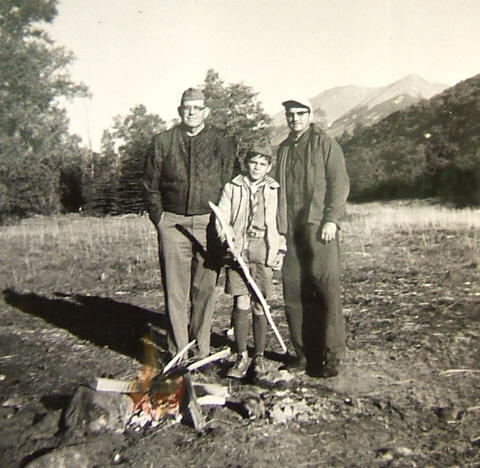
This photo is for the "Dear old dad" post below. I colored the fire.

Friday, October 21, 2005

Weekend words H

Wow, what a long day! We've received very few calls at work and almost no one is in the building. (It is Fall Break at the University and the students are not the only ones to have abandoned campus.) Adding to the annoyance of being somewhat idle indoors is the fact that the weather is absolutely splendid: blue skies, crisp air, marching band playing in the distance. Since the other person in this office comes in early and leaves early on Fridays, we engaged in a pre-prandial pingpong practicum. (Say that 16 times real fast. Or even three.) She won one game and I the other. We are trying to sharpen our skills so as to consistently beat our opponents in doubles.

Did you notice that none of the words in the preceding paragraph started with "H"? I was saving up for the weekend words. First we encounter a vocable which I've used with some frequency in my Sunday school class: HENOTHEISM. This has nothing to do with the idea that God is a hen. It's one of those history-of-religions words used to describe a stage in the progress from polytheism (belief in many gods) to monotheism (belief that only one God exists). Henotheists have a preference for one god, but don't necessarily dismiss the possibility of the existence of other gods. This seems to have been the condition of the Israelites for several centuries, at least to hear the prophets tell it. It seems that they had to explain over and over that images and idols had no real power. Isaiah 44 is a great example.

Once when we were in Kenya we stayed at a lodge built around a water hole. The animals would come (mostly at night and not for the water, which was pretty foul since water buffaloes wallered in it) for the salt which remained around the edges. We saw warthogs, elephants, hyenas, and so on. What we did not see (at the time) but heard was the HYRAX. It had a bloody screech which was quite unsettling in the middle of the night. We kept watching for some leopard-like feline but never saw a thing. A year later we were in Kenya again and actually came across a hyrax. It is about the size of a cottontail rabbit. That's right, a bunny. Here's a photo of one: rock hyrax.

And now for a poem. e.e.cummings wrote this in the first quarter of the preceding century. Hope I don't get in trouble for not securing permission to reprint it.

as freedom is a breakfastfood
or truth can live with right and wrong
or molehills are from mountains made
--long enough and just so long
will being pay the rent of seem
and genius please the talentgang
and water most encourage flame

as hatracks into peachtrees grow
or hopes dance best on bald men's hair
and every finger is a toe
and any courage is a fear
--long enough and just so long
will the impure think all things pure
and hornets wail by children stung

or as the seeing are the blind
and robins never welcome spring
nor flatfolk prove their world is round
nor dingsters die at break of dong
and common's rare and millstones float
--long enough and just so long
tomorrow will not be too late

worms are the words but joy's the voice
down shall go which and up go who
breasts will be breasts thighs will be thighs
deeds cannot dream what dreams can do
--time is a tree(this life one leaf)
but love is the sky and i am for you
just so long and long enough